Resharper VS IntelliJ -> Extract Class

I do a lot of work with IntelliJ these days and wanted to see if my favourite toolchain (Visual Studio + Resharper) provide a better experience for extracting classes. Here are my learnings.

I have a simple class with too many responsibilities. Easily to see via the "And" in the method name (Nitriq had this as a code rule since the beginning http://www.nitriq.com/).

Lets say I want to split up this class in a "Mapper" and a "XmlGenerator".

How would you do this?
How would you do this in an automated way?

5 things I learned about HTTP2 in an afternoon

This is a blog post for my future self as a reference for what I learned by googling and reading around the topic of networks and HTTP2.

What problems does HTTP2 try to solve?

In general, the web has a couple of issues today that people try to fix:
  1. Performance -> Slow websites, either on mobile devices, remote areas or bloated web apps themselves 
  2. Data usage -> There are still countries where people pay for bytes that go over the air
  3. Power consumption -> The power consumption has direct link to CO2 emission, which data centers try to keep low
  4. Privacy -> Is the web secure? Is your privacy secure?
Lets deep dive into the technical world... (photo from http://gratisography.com/ )

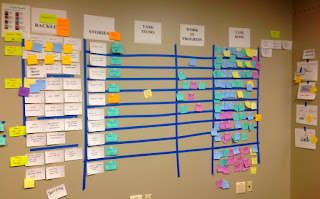
Cage Fight: Electronic VS Physical Boards

Every time I join a team that is physically co-located I propose to use a big-ass-board to track work and visualizes stuff. Usually, there are a couple of questions around these boards and I point people to different blog posts which I collected on my Brain Noise Blog http://gfader.tumblr.com/tagged/taskBoard.
This time I got 5 great reasons for using an electronic task board, that I want to answer here.

Cage fight!!!
Physical Boards VS Electronic Boards


Figure: Physical VS Electronic Boards - Thanks, Google Image Search

Peter, I think these are 5 advantages of an electronic task board. What do you think?

What bad developers say and what to do about it

I am still alive and I am still blogging, just not here so much ;-)
I blog more on my company Zühlke blog, on my technology tumblr blog Gfader brain noise, and another tumblr about Stop doing Agile - Business Agility - my adventures with organisations that want to improve.

So this is a little traffic generating, SEO link exchanging, cross post:


I talk to a lot of people (if the day is long enough) and so I get them to ask interesting questions like:

“What have you learned recently?”
or
“What is your top 1 goal for 2020?”

These questions and more leads us to interesting conversations about personal development and personal goals that a person has. Being a Scrum.org Trainer, I like to ask people questions especially related to software development so I ask them:

How well are your teams doing?

“How do you know?”

What do you think is the content of the ‘Professional Scrum Developer’ class?“.

Especially to the last question I get this face

No clue
Figure: “No clue” from http://xenaandjonesgiflibrary.tumblr.com/post/42761898144


Read the full blog post on our Zühlke Blog: 5 things bad developers say and what to do about it.

And by the way…

Here are the follow ups:

How do you apply changes to your codebase? When should we merge the JoeBranch?

At our yearly 1 week Zühlke web camp a couple of us took the opportunity to share experiences with branching and release techniques.

code changes workshop

TL DR;

  • Focus on Continuous Integration
  • Every change that you have locally is a branch (a code version that is different than main)
  • Every kind of branching delays Continuous Integration
  • Only a healthy code base with a “green” Build + Automated Tests let you sleep like a baby at night.

Are you a Professional?

What does it mean to be a Professional Scrum Developer?  
Figure: What does it mean to be a Professional Scrum Developer?


The future web development: where are we heading?

The web as we know it
Figure
: The web as we know it

The web is easy I thought 15 years ago, 15 years later I still haven’t mastered it. Here are some thoughts on the future of the web.

The TicTacToe Kata in C# – A TestDriven approach

This is for my future self to see how I look like on camera while coding ;-)
And I am doing another experiment to see if people are interested in this kind of stuff.

I turned on Camtasia and recorded myself during my weekly practice sessions. Published on youtube and now I wait and see what the reactions are.
Tools used: mstest, VisualStudio 2012, Resharper and Notepad.

The TicTacToe Kata in CSharp
Figure: Is the font big enough? Is my picture small enough? Is my voice annoying enough? Let me know!

How do you continuously improve yourself? An interview with SSW TV

This went viral on YouTube the other day, aka my mum clicked it 100 times.

Me and Adam Stephensen rambling around Clean Code, Quality, Releasing Software more often, Continuous Delivery and all things that make developers happy.
Figure: Me and Adam Stephensen rambling around

The Agile Manifesto 3.0

This is the 1st principle of the Agile Manifesto from the year 2001 that you can find on http://agilemanifesto.org/

Our highest priority is to satisfy the customer through early and continuous delivery of valuable software
Figure: First principle of the Agile Manifesto from 2001

How to increase the Code Coverage in 2 easy steps

As a developer you come to the point in time where a manager asks you to have at least 80% Code Coverage in your code.

Manager 
Photo Credit: Sam Foster

All managers love to see numbers, especially big increasing numbers.
I love big numbers too!

Combine Scrum and Continuous Delivery to drive Innovation

After publishing the paper on scrum.org here, I wrote a german version for the dotnetpro magazine of January 2013.

Check it out!
And make sure to buy the magazine!

Innovation through Scrum + Continuous Delivery [VIDEO]

Update 2014-11-05: Fixed the video link since the Scrum.org Video Channel moved.

I almost forgot to publish this recording here… Smile


Figure: My talk on youtube https://www.youtube.com/watch?v=TMyhhuQPEow

  • How often do you release your product to your end users?
  • How often do your end users see and use your product?
  • Do you release in sync with your Sprint length, after the Sprint Review?
  • Is the Sprint Review meeting the only valid release point?
  • When do you plan your releases?

See how the cadence of Scrum and Continuous Integration can help you build the right thing, and when implemented properly, release it on time to ultimately deliver superior value to your customers.

Efficiency and Effectiveness and some thoughts about it

What caught my attention recently: Efficiency vs. Effectiveness

Early enough to learn to code efficiently
Figure: Early enough to learn to code efficiently.    flickr

Use Scrum + Continuous Delivery to build the right thing

How do you get feedback?
Figure: How and how often do you get feedback?  flickr
The two topics “Scrum” and “Continuous Delivery” kept me very excited in the last years, which resulted in two presentations and a whitepaper for scrum.org.

Lean, Agile, Scrum Zurich conference slides

The Lean Agile Scrum conference 2012 is history.
This conference was a blast. All the discussions after and between the talks were superb, and getting to meet new people is always AWESOME (until a shark and a gorilla high-five each other in front of a en explosion –> Thanks Joe)

2 quick impressions from the conference

Arne Roock starting a Kanban sessionLunch and Apero - The best parts?
Figure: The pictures are so blurry because I was so excited to give a session later

My little contribution to this conference aka slides on SlideShare

Ease your Visual Studio development with a SQL Server alias

A quick little tip on how to manage connection strings in your applications with a SQL Alias that you can create with “SQL Server Configuration Manager”
SQL Server connection strings in app.config

First steps with Machine.Specifications (BDD framework)

Old machine. Where is the specification?
Figure: How do you specify this machine?

As you may have read in my previous blog post: On the road to BDD… Or… to see the light, I am dabbling more and more into the ATDD / BDD world.

These are my impressions from Machine.Specifications.
BTW: Gread video from JP Boodhoo about Getting up and running with MSpec

Code52 Show and Tell: My pet project CopyCat - Lessons learned

CopyCat – A big fat cat walking and waltzing the internetz

Figure: CopyCat – A big fat cat walking and waltzing the internetz
 

I am a pretty normal geek. At least I think I am normal and a geek. I see geeks as people (yes really) that want to play with things, discover new things and build things. When geeks play with things they discover new things quite often.
(Similar story heard and “adapted” from Scott Hanselman) 
After I ‘ve discovered something I want to scream it out to someone:

“Look at this dude!! Isn’t that awesome???”

A normal reaction that you get from a non-geek:

“Wow… Is this showing the weather in form of colors that you could just get by watching out the window?”

This is the pattern for the reaction that you normally get
“Wow… Is this <something> that does <somethingUselessAtBeginning> that you could just get by doing <somethingElse>?”

Reporting: 13 questions to answer before getting started

I get the following questions quite often and thought I gather my thoughts together in this blog post

  • “Which reporting components should we use in WPF?
    Is it Infragistics, Telerik, syncfusion”
     
  • “Is DevExpress XtraReports Suite still state of the art for reporting?”
     
  • “Do you prefer SQL Server Reporting Services (SSRS) over Crystal Reports?”

Figure: Not sure if I should respond or remain silent

Latest Posts

Popular Posts